What do you consider when visiting a place? Is it only the foods that you want to try? or you simply want to visit the place, and then go home? Well for me, I had to experience it myself before I realized that I was just visiting to experience it without knowing a thing about the place. I went because I’ve read about how beautiful it is. That’s it. So, how did I end up visitng this place? Yeah, just to visit because it is beautiful (according to google).

Not until I joined a group of travelers, who were at that time, listening to a tour guide and giving them instructions ( the itineraries).
It was when I started my very first “me–time travel” as I visited the Capital of Slovakia –– Bratislava. From the moment I heard about the history of the Place, it caught my attention and made me want to finish the whole–day tour.
And my quest begins now.
From Vienna, Austria you can travel directly to Bratislava, Slovakia as they have a one–day–travel ticket for the whole city, back and forth. This ticket can be used for any public transport only in Bratislava. It costs €16, which is definitely worth the price because I was able to use it more than 3 times plus the train from Vienna to Bratislava, and vice versa. However, the train station is not as big as the stations in Austria. It was at that time a bit congested inside the train station.
Going from one place to another is not that complicated. You can just simply google the place you want to go to and walk. Most of them are approximately 5 to 20 minutes apart from each other. The distance between the Old Town and the train station is less than 20 minutes. But, because it was still winter during my travel, I took the tram.
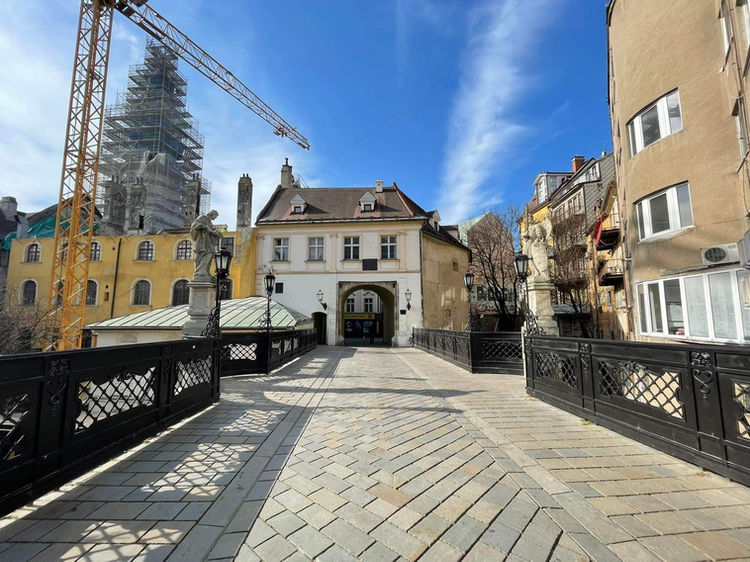
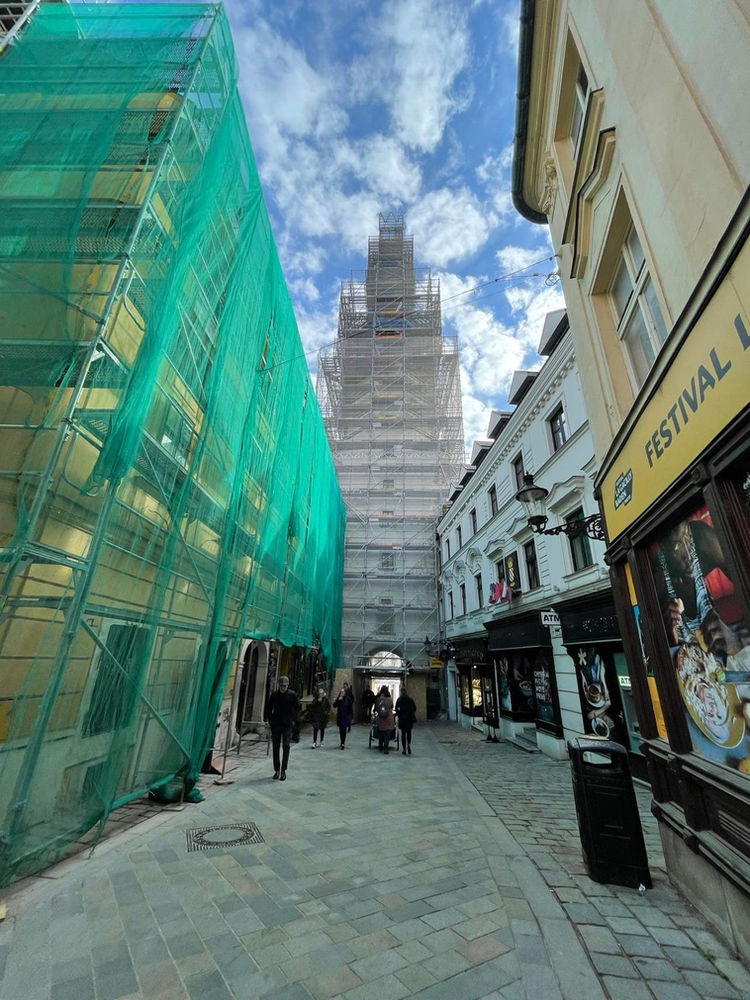
The first attraction I visited was Michael`s Gate, which was under renovation during that time. Not the whole place was being renovated but the building. Still, I was able to pass through the bridge as it is one of the entrances to The Old Town. On the right side of the gate is a jewelry shop.
Michael`s Gate is considered as one of the attractions in Bratislava because it is the last preserved gate of the medieval city fortification.

Schone (or Schöner) Naci was born in Petrzalka. His real name was Ignac Lamar and was the son of a shoemaker and the grandson of a famous clown with the same name. He was a poor man, who was wandering around Bratislava’s old streets, wearing a velvet frock and a tall hat. He greeted passers-by and he bowed to the ladies telling them I kiss your hand in German, Hungarian and Slovak. He wanted to give some happiness to his compatriots, exactly like his grandfather. A 20th c. legend. People really loved him and tried to help him. Occasionally he was cleaning properties to gain some money but usually he was given food by restaurants and coffee shops. He died in 1967 of tuberculosis. His statue was made by Juraj Melus in 1997.
According to the tour guide, they do not know wether Ignatius was mentally ill or not. It was really a sad story. But, because of the happiness that he brought to the people of Bratislava, after he passsed away, the people missed him. That`s why they built this statue to commemorate him.
Furthermore, according to the book of Lucy Mallows “Bratislava City Guide” Ignatius appears quiet friendly and jolly, but his fiance was deported to a Nazi concentration camp in WWII and died. Unfortunately, due to the trauma, he became psychologically impaired and was not able to recover from it.

A man peering out of a manhole cover `looking up skirts` by Viktor Hulik. In place since 1997 and the favorite photo op in town (Bratislava Travel Guides).
He is Čumil (not his real name) but rather a slovak word for “watcher”. According to the tour guide, locals do not really know his real identity. They just know him as the guy who`s resting after cleaning the sewers or looking under women`s skirts. But, he is said to give good luck or your wish will come true when you touch his head before exploring The Old Town, if and only if you manage to keep your wish a secret, forever!
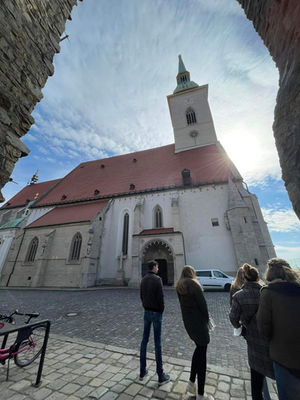
ST. MARTIN`S CATHEDRAL. Bratislava’s three-nave Gothic cathedral is built on the site of a previous, Romanesque church, dedicated to the Holy Saviour, from 1221. After 1291, when Bratislava was given the privileges of a town, the church was rebuilt to become part of the city walls (its tower served as a defensive bastion). The present church was consecrated in 1452.
The interior of the church is large – 69.37 metres long, 22.85 metres wide and 16.02 metres high – and features a grand internal divided portal with a preserved tympanum and a relief of the Holy Trinity.
It has four chapels: the canons’ chapel; the Gothic chapel of Sophia of Bavaria, widow of the Czech King Wenceslas IV; the chapel of St Anne; and the baroque chapel of St John the Merciful. The portal of the southern antechamber represents the oldest example of Renaissance architecture in Slovakia.
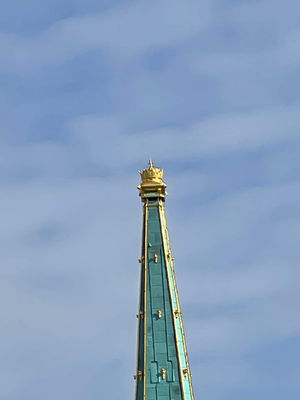
Between 1563 and 1830 St Martin’s served as the coronation church for Hungarian kings and their consorts, marked to this day by a 300-kg gilded replica of the Hungarian royal crown perched on the top of the cathedral’s 85-metre-tall neo-Gothic tower. Ten kings, one queen and seven royal wives from the Habsburg Dynasty were crowned in St. Martin’s Cathedral.
At the beginning of September each year the pomp and circumstance of the coronation returns to Bratislava in a faithful reconstruction of the ceremony.
The first monumental work of central-European sculpture made from lead can be found inside the cathedral. It was created by Georg Raphael Donner for the main altar of St Martin’s in 1734. The group is now in the side nave of the church as a free statue on a pedestal. It depicts St Martin sitting on a horse rampant, bending to a beggar and cutting his overcoat to share it with the poor man.
Source: https://www.visitbratislava.com/places/st-martins-cathedral/

OLD TOWN HALL is the oldest city hall in Slovakia. It was bombarded with cannonballs by Napoleon`s soldier in 1809. It was renovated and a part of this building is now a museum.
It was then that the original Romanesque house of Mayor Jakub became the property of the city. Over the course of time Unger’s House and Pawer’s House were annexed to it. The most complete element in the neo-Gothic reconstruction is the chapel of St Ladislav, with its unique wall paintings from the 15th century. In 1581 a renaissance arcade was added. The building normally houses the Bratislava City Museum, the oldest in the city (1868). When open, the museum features an exhibition of the feudal justice system, as well as the remarkable interior of the town hall building and original furnishings from the municipal court. In summer, cultural programmes are held in the beautiful renaissance courtyard and concerts are held in the tower. https://www.visitbratislava.com/places/old-town-hall/

But what is really interesting about this is the cannonball embedded in the facade. This cannonball, according to the tour guide and some articles that I have read, is one of several cannonballs collected from the bombardment of the city. Other cannonballs are located and embedded in some parts of the city.

Museum of Clocks – House at the Good Shephard and its collection
The House of the Good Shepherd is a rococo house from the second half of the 18th century in Bratislava. It is one of the best Rococo buildings in the whole of Bratislava. The house was built for a Bratislava merchant in 1760-1765 and belongs to several preserved original buildings of the Bratislava castle. It was reconstructed in 1975 and the Museum of the City of Bratislava opened an exhibition of historical clocks, displaying various types of clocks from the 17th to the beginning of the 20th century, but focusing mainly on workshops from the 18th and 19th century masters of Bratislava. The museum is called the Museum of Clocks.
Source: https://whichmuseum.com/museum/museum-of-clocks-house-at-the-good-shephard-bratislava-7782
I was not able to get in because we just passed by the place. But, it is also interesting because it is one of the preserved and oldest buildings in Bratislava. And according to the tour guide, the area was known as the Jewish quarter of the city.

The Lost Synagogue of the Lost City
Bratislava was for centuries an important center of Jewish life. The Jewish presence in the medieval city was regulated by a municipal charter granted in 1291 by King Andrew III Arpád. One section of this document stipulated that Jews had the right to reside within the city walls. Later, the Jews were expelled from the city on several occasions, the last time being in 1526. In 1599, they returned to Bratislava, but not into the walled town. At the invitation of Count Pálffy, they settled in a narrow zone between the castle hill and the city fortifications. Here, the so-called Judengasse, in an area under the jurisdiction of the castle, remained the only place Jews were allowed to live until 1840. Source: http://www.jewishbratislava.sk/history/
The red part on the map highlights the area where the jewish people have lived in Bratislava.
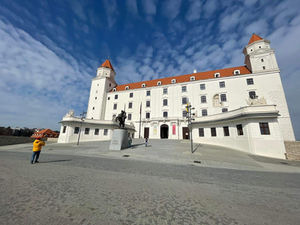
Bratislava Castle is the best attraction among all the others. The location of the Castle is really fascinating. I was able to see the beauty of the city from above and it was really beautiful and breathtaking. I did not go inside because I was not sure if visitors are allowed to enter it. But from the outside view of the castle and its surroundings, I could say that the Castle Tour was the best part. Actually, the castle offers free service, its comfort room is available for tourists. I did not utilise it but some did. It was my first castle visit that`s why I was so happy and amazed. In front of the castle is the Statue of Svatopluk the Great.
For more infos about the its history and renovation: https://www.slovakia.com/castles/bratislava-castle/
For more infos about Svatopluk the Great: https://spectator.sme.sk/c/20037145/erecting-the-statue-was-a-power-driven-act.html

This is the view from the castle. You can see the river, UFO (not seen in this photo) and many more. I did not go to UFO because I only had a one-day tour.I had no idea how much time I would need to go there and the waiting time, of course! Most importantly, I was not planning to eat there. Although it is one of the tourist attractions, I honestly didn`t want to visit the place because I already experienced that kind of view in Rheinturm, Düsseldorf and I was not so impressed (probably because it was night time). The view from the castle was already enough as I`ve seen the wonders of Bratislava from afar but close enough to appreciate every detail.

Slovak dishes are absolutely interesting and worth paying for! I`ve already been to 3 other european countries and I could definitely say that slovak dishes have distinct taste.
The tour guide gave me a list of some of the good restaurants in Bratislava. I would love to visit every restaurant there but I only had enough time so I followed my instinct and visited the restaurant with the longest name and that was Bratislava Flagship Restaurant. The place was cosy and and not overcrowded. The staffs were all friendly, accomodating and most importantly, the one who took my oders could speak english!

I ordered two different dishes and beverages that were absolutely new to my buds.
The price of their foods were affordable and served in big portion. That`s why I was not able to eat everything.
Creamy garlic soup and Pirohy are just some of the slovak dishes that you can find in this restaurant.
Creamy garlic soup comes with a bowl shaped bread where the soup is poured into. Because it was too big, I was only able to eat the soup and the top of the bread. I totally recommend this one!
Pirohy is a dumpling filled or stuffed with sheep milk cheese. I do not know exactly how to describe the taste of it. I would suggest that you only order a small portion and try it. It was a 50/50 for me. But, I still finished it all up.
For the beverages, I asked the waiter for their local drinks and they gave me these two. I would rate both wine and beer 11/10!! I got a bit drunk but still I was able to go home lol. In all, I was very satisfied.
For more info about the resto: http://www.bratislavskarestauracia.sk/de/
This is the link or website of the Tour Guide : www.freetourbratislava.com They offer extensive tour and more. I gave the guy €10 tip but that depends on your willingness to give.

These are just some of the photos I got from Bratislava. If you are planning to see the ebtire beauty of Bratislava, I suggest that you stay for at least 2 days there, so that you would be able to visit most or all of its attractions.
 A Wanderer’s Guide